Let discovery proceed in Hyde School case

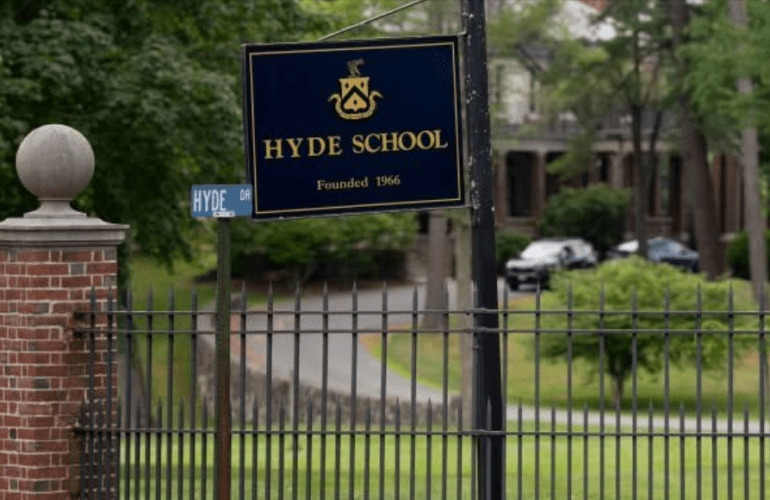
The federal lawsuit brought by former Hyde School student Jessica Fuller is now at a critical stage. The court must decide whether discovery will proceed, potentially opening access to internal emails, disciplinary policies, records, and sworn testimony.

Recent attention surrounding the case has focused on court sanctions issued over inaccurate AI-generated legal citations included in filings by Fuller’s attorney. While the judge addressed those procedural errors directly, the larger question before the court remains unchanged: whether Hyde School’s practices and disciplinary culture warrant further examination through discovery.

Will the court allow discovery to proceed?

For former students like myself, discovery is not simply a procedural phase buried in legal process. It represents something far more significant: the possibility of transparency.

Discovery could provide the first meaningful public examination into the systems and practices that shaped the lives of countless students over decades. That possibility matters not only to plaintiffs, but to former students, parents, educators, and the public itself.

For years, Hyde School has presented itself as a place of character development and transformation. Many students experienced it differently.

One of the most psychologically damaging aspects of Hyde’s culture was a practice known as “Brother’s Keeper,” which encouraged students to monitor and report one another. Supporters may describe this as accountability. But for many students, it created an atmosphere of fear, distrust, emotional isolation, and constant surveillance within peer relationships.

Students lived with the fear of being reported. Fear of public humiliation. Fear of disciplinary consequences. Fear of disappointing parents who had been led to believe the program was necessary for their child’s success or survival. Many students internalized the belief that ordinary adolescent mistakes, emotional struggles, or acts of rebellion were evidence of deep personal failure.

Privacy became suspect. Loyalty to friends became morally questionable. Students learned quickly that peers could become informants at any moment.

This was not simply about discipline. It shaped the emotional environment students lived inside every day.

Former students have spent years trying to explain the long-term effects of these systems. Many were dismissed as bitter, troubled, or unwilling to take responsibility for themselves. Others stayed silent entirely, unsure whether anyone would believe them.

Now, for the first time in a long time, many are watching this lawsuit with cautious hope, not because they seek revenge, but because they seek examination.

Discovery is not a declaration of guilt. It is a process that allows evidence to be seen. If Hyde School believes its practices were ethical and beneficial, then transparency should not be feared.

But if this case is dismissed before discovery occurs, many former students will once again be left with the same message they have carried for years: that their experiences do not warrant investigation.

This case is larger than one lawsuit. It speaks to broader questions about institutional accountability, adolescent vulnerability, and what can happen inside environments operating largely beyond public scrutiny.

The court now stands at an important threshold.

I hope the court chooses transparency over silence.

Let discovery proceed.

Still waiting on accountability from Hyde School – Published Portland Press Harold 2/11/26

It has been over six months since former student Jessica Fuller filed a lawsuit against Hyde School. She claims students endured abuse, forced labor, and lasting emotional harm.

The case is still active, but it is moving slowly, not because the claims lack merit, but because of legal rules. Since the lawsuit was filed in Maine, Fuller needs a local lawyer for the court to proceed. At the same time, Hyde has asked the court to dismiss the case entirely before it even reaches trial.

Right now, the court has not ruled on whether the claims are true, only on whether the case can continue. That means the story is far from over, even if the process feels frustratingly slow. The motion to dismiss, which would prevent the case from being fully examined, is telling.

What is most troubling, regardless of legal outcomes, is Hyde School’s continued refusal to acknowledge or take responsibility for the harm reported by former students over decades. Accounts include allegations of physical mistreatment, forced labor framed as discipline, and systems of emotional manipulation that blurred boundaries and caused long-term damage.

Music and Motherhood

Music has always been my quiet translator. It reaches places language cannot, steadies my nervous system, lifts me when I am low, and on the hardest days reminds me that there is meaning, rhythm, and a reason to keep going. Music has been the thing that told me, gently but firmly, that I was going to be okay.

Motherhood, especially in the early years, has a way of setting aside many of the things that once felt essential. Not lost, just postponed. Placed on a high shelf for “later,” whenever later decides to arrive.

These days, most of my soundtrack is kid approved. In the car, while making dinner, packing lunches, wiping counters, anything to keep the peace and prevent a full meltdown. Children’s music fills the house because silence feels risky and screaming feels worse. This is not a complaint. It is survival.

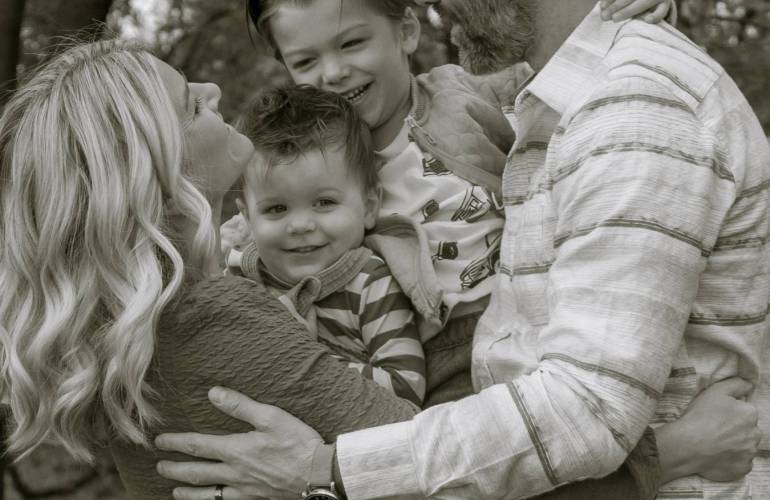
And honestly, I have embraced it. I have excellent kid playlists. One of my favorites is reggae versions of children’s songs, yes including The Wheels on the Bus, which somehow keeps all of us moving. We dance. We wiggle. We sing. We even have a karaoke machine with three microphones, one for each boy and one for mama.

But lately, I have been testing the edges.

I have been reclaiming pieces of myself in small, almost invisible ways. An inch here. A moment there. This morning, on the hour long drive to my mother’s house and back, instead of zoning out or surrendering to exhaustion, I played my own music. Not kid music. Not compromise music. Mine.

And my boys were fine.

As the miles passed, something familiar stirred. That old feeling of joy and possibility came rushing back, like a part of me waking up after a long sleep. I felt connected to the version of myself that existed before children, and also to the woman I am now. Tired. Overworked. Doing the invisible labor of a household that never truly rests.

That feeling is not new to me. It lives in The Pace of Nature as well. Lilly feels it too, that deep pull toward music as refuge, as truth teller, as the place where she can breathe without explaining herself. Music is where she remembers who she is when the world asks her to be smaller, quieter, more manageable. In that way, Lilly and I are not so different. We both know what it means to lose ourselves to responsibility and expectation, and how music becomes the thread that leads us back.

It made me wonder why I ever stopped listening to the things that light me up from the inside. The songs that loosen something in my chest, that shake the dust off my spirit, that remind me I am more than a mother, a chauffeur, a cook, a cleaner.

Motherhood asks a lot. Sometimes it asks for everything. But maybe it does not have to ask for this too.

Maybe letting my music back in, even just on a drive, even just for an hour, is not selfish. Maybe it is essential. Maybe it is how I stay aligned with my own pace of nature, how I remember myself, and how my boys get to know me not only as their mother, but as a whole person who still listens to what moves her.

And honestly, that feels like a rhythm worth keeping.

Writing, Motherhood, and The Pace of Nature

Being a writer with two young children is intense. Before having kids, writing was my life. I wrote to get published, to craft and polish The Pace of Nature, and to make it the best story it could be, which I now believe it is. Taking two years off from writing, although painful at the time, was probably the best thing I could have done for this story. Returning to it with fresh eyes, after becoming a mother of two, gave me perspective I didn’t have before. This story, based on true experiences, has always been incredibly close to my heart. Coming back to it as a different person, with a whole new lens shaped by motherhood, made it stronger than I ever could have imagined.

Before having children, writing was my main priority. My first son changed everything. I loved becoming a mom and had waited my whole life to hold him in my arms, yet I felt defeated for not having the time to continue building my writing career. Writing had always been my first baby. The Pace of Nature felt like a child I had created and nurtured, and stepping away from it felt impossible at first. But the distance allowed me to return with clarity, to strengthen the story, deepen the characters, and shape it into the novel I am proud of today.

Finishing the novel this past July through October was amazing but completely exhausting. As a mom of two young boys, I had read about moms waking up at 5:00 am to write their books and wondered how that was even possible. Experiencing this firsthand, writing from 5:00 to 6:30 a.m. and grabbing twenty minutes whenever I c ould, I quickly realized how hard it is to balance the chaos of motherhood with the focused demands of creating a story.Getting two young boys ready in the morning is a full-time job: getting them dressed, fed, shoes on, cleaning up after breakfast, handling laundry, making lunch, cooking, and cleaning again. Writing consumes your imagination, and during those months, I often found myself not fully present with my children. A new line or scene would pop into my head, and my attention would drift away from them. I didn’t like that.

This experience taught me something important: I want to be fully there for my boys. Those months of writing were incredible, and I believe The Pace of Nature was created with magic. But I am happy to be done with the intense creation phase. My boys are so young, and they are growing so fast. I don’t want to miss a beat. That said, The Pace of Nature is finished. I am submitting to agents and publishing houses while my four-year-old is at school and my two-year-old takes his daily three-hour nap. But I am no longer waking up at the crack of dawn to create or to market. I am exhausted and want to have energy to keep up with my two wild boys.

For now, I’m grateful for the quiet gift of three days a week – time to submit, to write, to share pieces of the work, and to search for the right marketing partner who can help carry The Pace of Nature into the world when the moment arrives.

If the novel does not find a home in traditional publishing by Fall 2026, I plan to self-publish no later than January 2027, trusting the story to meet its readers in its own way.

Thank you, as always, for your steady support. Sending much love to you all in the new year.

The Pace of Nature is finished!

Just last week, I typed the final words I’ve been working toward for years: The Pace of Nature is finished. The last round of edits is done, and the manuscript is now officially out in the world.

I’ve started submitting to agents. I’m giving the traditional route six months. I’m giving the traditional publishing route one more shot. I’ve worked hard for this, I’m a professional writer with a degree in writing, and it’s always been my dream to be traditionally published. To see my book on shelves. To hold it in my hands and know I earned my place there.

But I also want to be honest: if the traditional path doesn’t land where it needs to, I’m prepared to self-publish, and to do it with intention, not as a last resort.

That means I’m currently deep-diving into what it takes to publish a book independently the right way:

  • Building a target audience
  • Growing an email list
  • Preparing a book launch strategy
  • Researching book marketing and PR
  • Identifying who I want to work with when it’s time for a campaign

If I self-publish, it will be professional, strategic, and fully backed by a marketing plan, not a “throw it online and hope” situation.

Who This Book Is For

The Pace of Nature will resonate with people who know what it means to survive something, and still be learning how to live afterward.

It will appeal to:

  • Survivors of reform and boarding schools
  • Individuals who have experienced trauma and are seeking a story of healing and resilience
  • Mothers struggling to connect with their teens
  • Teens who feel misunderstood or disconnected from their parents
  • Parents raising children with disabilities
  • Young people with learning challenges who need encouragement and representation
  • Readers drawn to stories of emotional endurance, redemption, and self-discovery

Help Me Build This Community

As I move into this next phase, I’m starting to build my email list. This will be the main space where I share monthly updates, behind-the-scenes insights, early release news, and eventually, launch details.

If you’d like to follow along and be part of this from the beginning, send your email to:

BrittDiGiacomo@gmail.com

I’d love to have you along for the journey.

Below is the pitch I’m currently sending to agents and editors. If the story speaks to you, keep reading. There’s so much more coming. Thanks for the support!!

The Pace of Nature

At seven, Lilly thought the hardest thing she’d ever have to overcome was the accident and her brain injury. Little did she know that at sixteen she would face an even greater challenge: the daily humiliations, forced confessions, and psychological games at Forge Academy, a “therapeutic” boarding school that pulls parents into its system just as tightly as it controls their children.

At home, Lilly’s life spirals between shame and self-punishment. Haunted by her mother’s constant reminders of the accident, she lashes out at classmates, breaks things in anger, and ends up in the hospital after one of her worst episodes. Her body heals, but her self-worth doesn’t.

Lilly is desperate to change, to become someone her family could believe in again. But Forge thrives on punishment disguised as progress. Classes are canceled for group shaming. Students stand for hours in the Arena of Shame. Meals are withheld. Every breath is a test of obedience.

Burdened by the learning difficulties that have always made her feel behind, Lilly fights to stay afloat in a place designed to break her. Then she meets Meisha, a gifted pianist whose talent and quiet confidence awaken something in her, a reminder that beauty can exist even in captivity. Shauna, her sharp-witted roommate, becomes both a lifeline and a mirror, showing Lilly what strength looks like under constant control. And Nora, the rule follower who betrays her in the worst way, teaches her how fragile trust can be.

But just as Lilly begins to rebuild her sense of self, she’s forced to choose between protecting her progress and protecting a friend. What follows is a reckoning with loyalty and the quiet courage it takes to save yourself without abandoning the people who shaped you.

The Pace of Nature is a tense, emotionally charged story about resilience, first love, and the brutal systems that call themselves your savior. Inspired by true events from my life as a former student of Hyde School, a boarding school that claimed to help troubled teens but is now facing a lawsuit for emotional and physical abuse, this story was born from what I witnessed and survived.

Shadows and Secrets -Published Woman Around Town 8/30/25

Shadows and Secrets

There was a time when mornings
unfolded slowly,
Italy’s cobblestones beneath me,
France’s light brushing my skin.
Days filled with yoga,
pedicures, unhurried walks
with my dog,
and sleep like the world owed me
every dream.
I woke late, lingered
on the patio with a book,
the sun warm on my shoulders,
time, a current
I drifted upon.

The Transformation from Hyde to Forge Academy

Why Hyde Became Forge

The first time I understood how Hyde really worked, I was sitting across from my best friend in the dorm’s common room. The overhead lights buzzed, too bright, making the shadows under her eyes stand out. She had been gone for hours, pulled into an interrogation I knew little about. Now she sat hunched forward, hands tangled in the drawstrings of her sweatshirt, twisting and twisting until the cord was frayed.

She wouldn’t meet my eyes. I could hear the hum of the vending machine, the muffled footsteps of staff pacing the hallway just beyond the door. Finally, in a voice that cracked halfway through, she told me she had turned me in. Not because she wanted to, but because they had cornered her, threatened harsher punishment if she stayed silent, promised her a way out if she confessed and gave up someone else.

It was like watching the air leave her body as she said it, her shoulders collapsing under a weight neither of us could carry. In that moment, I learned what Hyde thrived on: fear that seeped into every friendship, pressure that bent loyalty until it snapped, and betrayal recast as “character building.” Trust was dangerous. Silence was punished. And the walls were always listening.

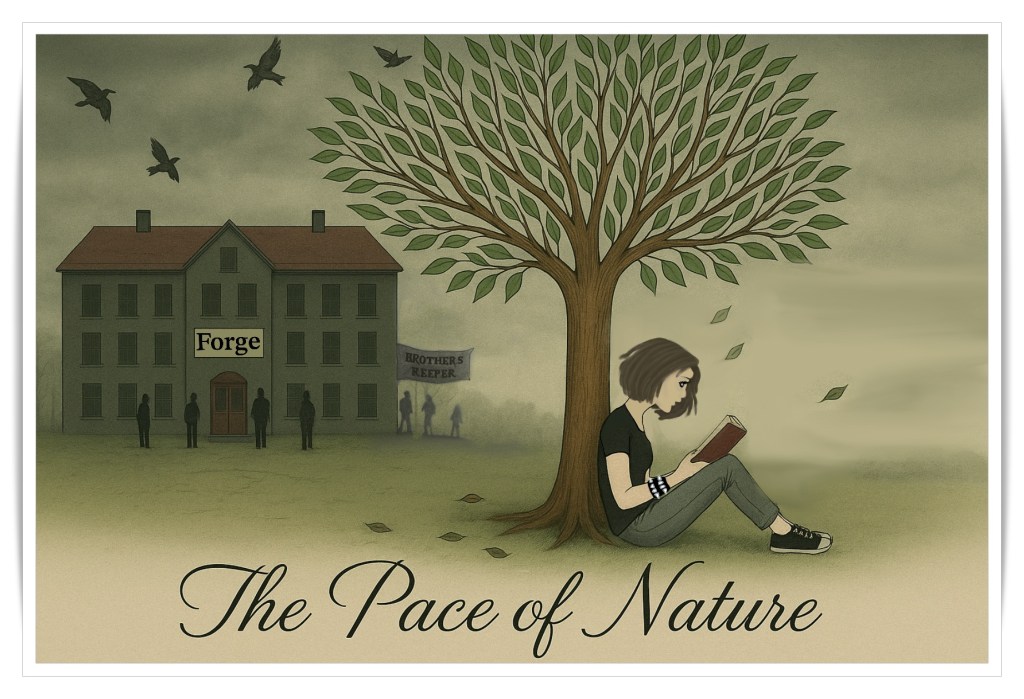
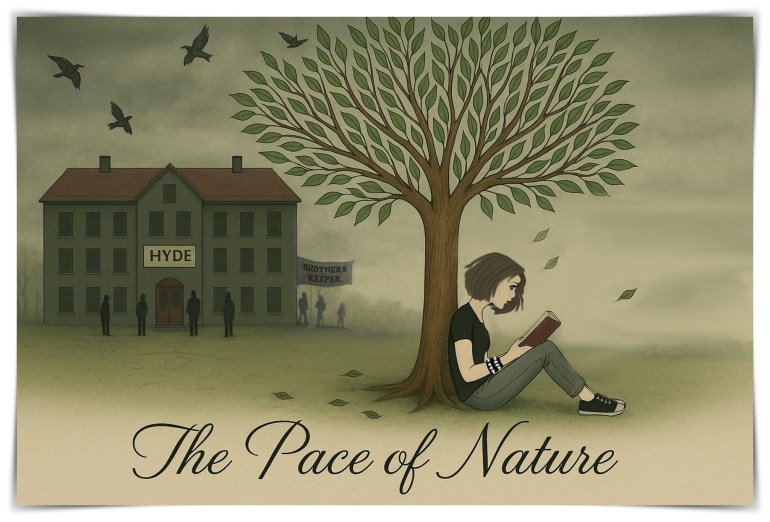
When I began writing The Pace of Nature, I thought I would keep the school’s real name: Hyde. After all, it was where the story unfolded for me. But as the pages built up, Hyde transformed into Forge Academy.

The change was partly necessary, due to legal caution, privacy, the truth that no single account can ever capture the whole story. But it was also intentional. By renaming the school, I gave myself room to blend fiction with lived experience. Characters could be merged, events reshaped, and the narrative could hold not just my memories, but echoes of many. Forge became the crucible where it all burns down and takes shape again.

It’s been a whirlwind diving back into The Pace of Nature these past six weeks. I had put the novel on hold after my second son was born, due to being stretched too thin. And honestly, these past weeks have felt the same: pulled in every direction, between running a business, raising my boys, and now pouring myself back into getting this book ready for publication.

The days start at 5:00 a.m. and often end at midnight, every free minute crammed with edits, proposal drafts, blog posts, research. It’s exhausting. But I wouldn’t have it any other way. Because now is the time for my story to be heard.

I want to expose Hyde’s harmful “Brother’s Keeper” policy and their warped version of discipline that caused so much pain. Since the lawsuit was filed, countless people have reached out with their own stories.

Their voices are the fuel that keep me moving forward.

The more we speak, the more we refuse to be silenced, the more change can finally take root. We survived their system. Now we’re dismantling it. One story at a time.

The Hidden Harm of ‘Brother’s Keeper’ at Hyde School, by Britt DiGiacomo published by Hearst Media, appeared in print in The Norwalk Hour 8/3/25.

This summer, Hyde Boarding School in Bath, Maine was hit with a federal class-action lawsuit, one that echoes what many of us have known for years.

The suit, Fuller v. Hyde School, alleges forced child labor, emotional abuse, and coercive practices masked as “character development.” Since its filing, dozens of alumni have come forward with similar stories. I’m one of them.

I attended Hyde School’s Woodstock, Connecticut campus for three and a half years. While parts of the experience, particularly family therapy, brought growth, one aspect of Hyde’s culture never left me: the brutal enforcement of “Brother’s Keeper.”

On the surface, Brother’s Keeper sounds like integrity, students holding each other accountable. But in practice, it created a hierarchy of informants and interrogators. The system rewarded betrayal, punished privacy, and manufactured fear.

Introducing The Pace of Nature: What Happened at Hyde

The Pace of Nature is a two-novel series I began writing in 2010 for two reasons:

  1. I believed I had an important and compelling story to tell.
  2. I wanted to help people, especially those who’ve been told who they are before they ever had a chance to figure it out for themselves.

I wanted to show that just because someone, whether a doctor, a parent, or a so-called authority, smacks a label on you, it doesn’t mean you have to accept it. You can reject their version of your story and write your own.

The Pace of Nature is set in two primary places: home and Hyde. These were the two worlds that shaped me, one rooted in family, and the other in forced reinvention.

When I entered my MFA program in 2014, I seriously considered telling this story as a memoir. I tried. I drafted sections as personal nonfiction. But I kept running into a wall, one that I think many writers face when mining personal history. I realized I couldn’t write intimate truths about my family or the people from Hyde and claim them as the truth. Because truth isn’t singular. Everyone sees through a different lens.

Take the house I grew up in, for example. I remember it as light, grand, and full of places I could disappear into. One of my sisters remembers it as dark, crowded, and hard to breathe in. Both are true, in their own way. That’s the problem with memoir: it asks you to write your truth as the truth, and I couldn’t do that in good conscience.

So after a few different versions, I landed on telling the story through fiction, specifically, through the voice of a character named Lilly Difeo. Writing in the first person, from Lilly’s point of view, gave me space to speak my truth without claiming ownership over anyone else’s. It gave me room to explore memory, emotion, and experience with honesty and creative freedom.

The Pace of Nature is based on true events from my life. It’s creative nonfiction disguised as a novel.

But for now, what I want you to know is this:
Sometimes fiction can tell the truth better than fact ever could.

Next week, I’ll share more about Lilly Difeo, who she is, how she came to be, and why I chose her to carry this story. I’ll also begin pulling back the curtain on The Pace of Nature itself – its themes, its secrets, and the personal experiences that shaped its pages.

Home gave me silence. Hyde demanded confession. This is the story of what broke, and what survived. 

Hyde Lawsuit: The Damage of “Brother’s Keeper”

Hyde Lawsuit: The Damage of “Brother’s Keeper”

Hi there! I wanted to share an update regarding the recent lawsuit against Hyde School—especially since I left this out of my last post and received a lot of feedback and interest.

What I Know

  • federal class-action lawsuit (Fuller v. Hyde School, Case No. 2:25-cv-00354) was filed in July 2025 by former student Jessica Fuller.
  • The complaint alleges:
    • Forced child labor
    • Emotional abuse
    • “Attack therapy”
    • Compulsory physical punishment (known as “2-4”)
    • Public shaming rituals
  • All of this was framed under the guise of “character development.”
  • Since the suit was filed, dozens of alumni have come forward with similar stories.
  • Hyde has denied all allegations.

What troubles me is Hyde’s complete denial. I understand wanting to protect a legacy—but when that comes at the expense of truth and student well-being, it’s dangerous. Too many people have been hurt.

And this isn’t Hyde’s first lawsuit.
You can read more about that here.

You can hear Jessica and other’s story here.


The Damage of “Brother’s Keeper”

One of Hyde’s five core ethics, “Brother’s Keeper,” is based on the idea that students should hold each other accountable and report one another when they break a rule or “ethic.”

In theory, it sounds like integrity.
In practice, it was a tool for shame, control, and psychological harm.

Here’s how Brother’s Keeper typically played out:

  • A student breaks a rule.
  • Another student reports them to the Dean’s Area.
  • The Dean interrogates the student and demands names of anyone else “dirty.”
  • Those students are then interrogated.
  • In some cases – often a few times a year – a full school bust would be declared.

Then came the public spectacle:

  • Students are called on stage in front of the entire school.
  • They’re forced to “come clean” and confess deeply personal acts—often involving sex or drugs.
  • The Dean would sometimes ask for explicit details in private sessions.

If you weren’t called on stage, you may be sitting in the audience, sweating, terrified, wondering if your name was next.

And if your name did come up? Your parents were often contacted immediately and manipulated into believing you weren’t “ready” for the real world.

Meanwhile:

  • Students were divided – you were either “dirty” or “on track.”
  • Seniors who seemed “on track” were often revealed to be breaking the same rules behind closed doors.
  • The system bred hypocrisy, fear, and mistrust.

Recently, someone reached out to share that after they graduated from Hyde, their former roommate, who was still enrolled at Hyde at the time, turned them in for an ethic violation they had both been involved in. A staff member later contacted this person at college, shamed them, and asked them to return their diploma.

This was after they had already graduated from Hyde, moved on, enrolled in another school, and were doing well.

This person was thriving, focused on their future, working hard. And yet, Hyde couldn’t let it go.

How dare you graduate dirty? That’s the message they sent.

There were also cases where seniors were accused of being “dirty” – whether true or not – and Hyde would decide to hold them back, even when they had the grades to graduate. At any other school, they would have walked. But Hyde expected total rule-following, and if you didn’t meet their definition of “ready for the real world,” they convinced your parents to keep you another year. It didn’t matter that you were a teenager, learning and making mistakes like any young person does. What could have been a milestone moment – graduation – was taken away. At Hyde, they called it character development. But really, it was another year of control, and another year of your parents’ tuition.

During my senior year, in the midst of a school-wide bust, I remember gripping the edge of my seat while another student stood on stage, sobbing as she confessed things that never should’ve been anyone’s business but her own. I stared at the floor, barely breathing, praying my name wouldn’t be called next.

I was terrified. Afraid of what my family would think. That everything I had done to change, to earn back their trust, would be erased. I was terrified they’d believe Hyde over me. That they’d see me as a failure all over again. That they wouldn’t let me come back home.


Why Does Brother’s Keeper Trump Everything Else?

At Hyde, the message was clear: coming clean about breaking a rule, especially when someone else turned you in, mattered more than almost anything else.

Your academic progress, emotional growth, family relationships – even your leadership on the field – none of it mattered once you were labeled “dirty.”

So why?
Why did Hyde treat rule-breaking, and the public confession of it as the pinnacle of character development?

At Hyde, confession equaled transformation, regardless of the damage it caused. Integrity wasn’t measured by your values or growth over time, but by whether you confessed, turned in others, and accepted consequences without resistance. Loyalty to the institution mattered more than loyalty to yourself. And if you resisted, even quietly, you were seen as manipulative, dishonest, or not ready for the real world.

So when a student:

  • Kept something private because it was personal…
  • Refused to expose a friend out of loyalty…
  • Struggled to “come clean” in a public setting…

They weren’t seen as someone with boundaries or quiet integrity.
They were labeled as dishonest, untrustworthy, or not ready.

They didn’t just want you to follow rules.
They wanted you to confess, collapse, and rebuild yourself – under their terms.

The Cost of That Thinking

Students who had worked hard to earn trust, repair family relationships, or stay committed to schoolwork could have everything torn down in one day, simply because they made a mistake and didn’t report themselves first.

It wasn’t about accountability.
It was about reinforcing Hyde’s grip on your identity.

And if you resisted?
If you felt ashamed but didn’t want to share your private life on a stage?
You were told you were hiding, manipulating, not ready for the real world.

In Hyde’s eyes, you were only as good as your last confession.

Hyde, the world doesn’t need more control disguised as character.
It needs compassion, accountability, and growth. It’s time to break the cycle.


Where I Go From Here

I want to share that I’ll be self-publishing my novel, The Pace of Nature. I’ve spent the past week diving back into the manuscript, and I know now – this is the time to tell my story from beginning to end.

  • How did I end up at Hyde Boarding School?
  • What happened while I was there?
  • Why were my parents so desperate to send me to a place like that?

These are the questions my novel will explore.

Starting next Sunday, I’ll be posting weekly updates to walk you through the journey leading up to the book’s release.

Thank you for your continued support.

To my fellow Hyde classmates:
I’ve received countless messages this week from people sharing their stories. If you have something to say, anonymously or not, please email me.

I’m here to listen, and I’m here for you. Always.
📧 BrittDiGiacomo@gmail.com

How You Can Help

If you’re reading this and wondering how to support those affected by Hyde or similar institutions, here are a few ways:

  • ✅ Believe survivors. Even when their stories are hard to hear.
  • 📣 Share this post to raise awareness about abusive “character-building” systems.
  • 🧠 Educate yourself on trauma-informed practices and coercive control.
  • 🗣 Speak up if you see similar systems of shame or manipulation in your own schools or communities.
  • ❤️ Offer compassion, not correction to those who are still healing.